今天
今present天day=today
A person with a line overhead — that's the sky!
Practice 天 in the interactive lesson天 is a person with a line drawn above the head — that line is the sky, the heavens. Stand tall (大) and the sky covers you. The ancient Chinese saw 天 as the vast power above all people, the dome that shelters the world.
Chinese words often combine short meaning clues. Fixed expressions are clearly marked so you do not translate them too literally.
明天 is a fixed time word; 明 does not simply mean “bright” here.
天 is documented as a basic character form. Its earlier written forms gradually became the regular-script shape used today.
In modern simplified Chinese, 天 is written with 4 strokes. This lesson separates documented shape history from the memory story so learners do not mistake a mnemonic for a historical claim. 天 works as one complete form rather than a puzzle made from smaller modern components. Learning its overall silhouette is useful because the same shape may later appear inside more complex characters.
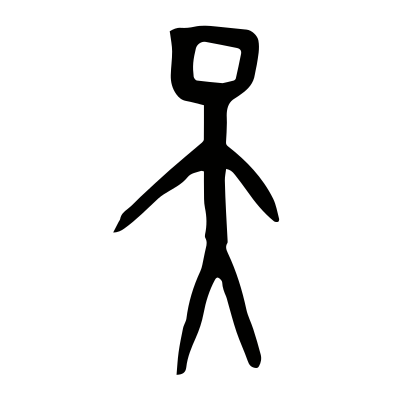
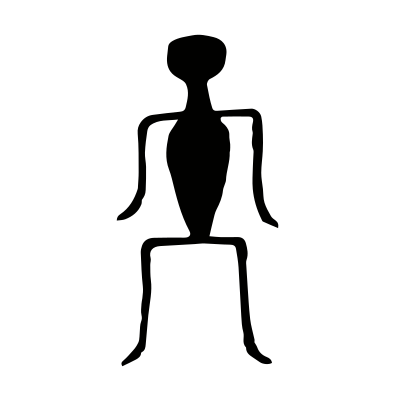
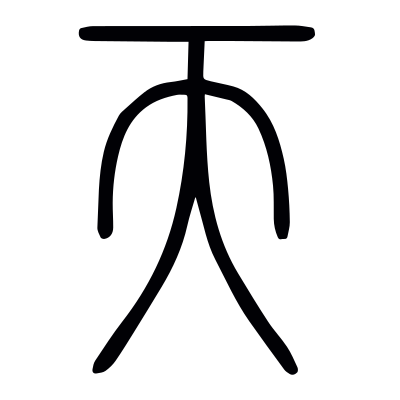
天 is written with 4 strokes. Learn the complete stroke sequence in the interactive lesson, then write the character from memory before checking your answer.
The examples below show 天 in complete beginner-friendly sentences. Read each sentence aloud, notice where the character appears, and then replace one noun or number to create a new sentence of your own.
Learn the reading as one unit: tiān, with the first tone: high and level. Avoid memorizing the letters without the tone mark. Say the syllable, recall the English meaning “sky, heaven,” and write the 4 strokes from memory.
Because 天 is a basic form, focus on its proportions and stroke direction. Compare it with 大 (dà, big — the base of 天); 夫 (fū, husband — big (大) + a mark); 太 (tài, too — big (大) + a dot). Similar characters are easier to remember when their different parts and meanings are studied side by side.
Use the Chinese radicals and components guide to understand reusable parts, the stroke order guide to improve handwriting, and the HSK 1 character overview to choose your next beginner lesson.
HanziStory separates documented character history from modern memory stories. Historical-form images are shown only when a matching source file is available; missing stages are skipped rather than invented. Stroke practice uses HanziWriter data.
Last updated: August 12, 2026. Read our sources, editorial method, and correction policy.