Start high and hold the pitch steady. Do not let the end fall like an English statement.
Beginner pronunciation guide
Mandarin Chinese Tones
Learn the four main Mandarin tones, the neutral tone, where pinyin tone marks go, and how tones change inside real words.
Why tones matter in Mandarin
A Mandarin syllable includes an initial sound, a final sound, and a tone. The tone is not decoration added after the word; it belongs to the pronunciation. Changing the pitch pattern can change which word a listener understands. English also moves pitch up and down, but often uses that movement for attitude, emphasis, or questions. Mandarin uses pitch movement to distinguish syllables as part of ordinary vocabulary.
Beginners often remember the letters and postpone the tone. That creates two separate memory jobs: first relearning the word, then attaching the missing pitch. A better habit is to learn nǐ as one sound unit rather than learning ni and adding the third tone later. Every HanziStory character page keeps the tone mark beside the character and provides a pronunciation button so sight and sound can be learned together.
The four Mandarin tones and neutral tone
Imagine your comfortable speaking range as five levels, from low to high. The arrows below are memory aids, not musical notation. Keep the whole syllable connected while your pitch moves.
Begin around the middle and rise clearly, similar to the lift in a short surprised “Really?”
In isolation it falls and may rise. In connected speech it is often mainly low; the full rise is not always heard.
Start high and drop firmly. Keep it short and controlled rather than shouting.
Say it briefly and without a full tone contour. Its exact pitch depends partly on the tone before it.
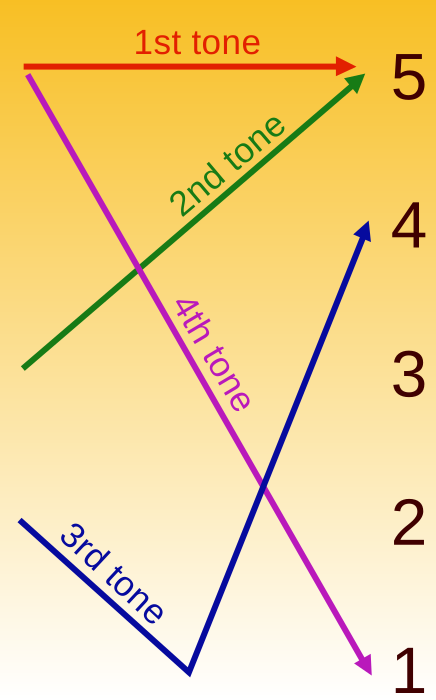
Tone chart by Wereon, used unchanged from Wikimedia Commons under CC BY-SA 3.0.
For an independent beginner introduction, see the Open University’s Mandarin tones lesson.
How to read tone marks in real character lessons
他tā = hefirst tone →
人rén = personsecond tone ↗
你nǐ = youthird tone ↘↗
是shì = to befourth tone ↘
个ge = measure wordneutral tone ·
Open each lesson, press Listen, and imitate the whole syllable. Then look away and say the pinyin from memory. Hearing, producing, and recalling the same item builds a stronger connection than silently reading the tone name.
Where to place a pinyin tone mark
The mark belongs on the vowel that carries the syllable’s main written tone. Use this practical order:
- If a is present, mark a: hǎo, jiā, kuài.
- Otherwise, if e is present, mark e: xué, hē, lèi.
- In ou, mark o: yǒu, kǒu, hòu.
- For many remaining two-vowel endings, mark the second written vowel: liú, shuǐ, guì.
Tone numbers are useful when a keyboard cannot type marks: ni3 represents nǐ. For learning materials, tone marks are easier to read because the pitch information stays directly on the vowel.
Three tone changes beginners should know
Two third tones
When two third-tone syllables occur together, the first is commonly pronounced with a rising contour. nǐ hǎo is therefore often heard approximately as ní hǎo, although the dictionary pinyin keeps both original marks.
一 changes in phrases
一 is yī alone and in ordinals. Before a fourth tone it is commonly yí, as in yí ge. Before many first-, second-, or third-tone syllables it is commonly yì.
不 before a fourth tone
不 is normally bù. Before another fourth-tone syllable it is commonly pronounced bú, as in bú shì. The written character does not change.
Common beginner mistakes
- Using English stress instead of pitch: making one syllable louder does not replace the required tone contour.
- Over-performing every third tone: the full fall-rise is clearest in isolation or at the end of a phrase. Inside a phrase, a low third tone often sounds more natural.
- Ignoring neutral syllables: common items such as 个 ge and 们 men are light and short in many everyday words.
- Practising only with the eyes: pinyin describes pronunciation, so every reading exercise should include listening and speaking.
A 10-minute Mandarin tone routine
- Warm up with one syllable across the four tones: mā, má, mǎ, mà.
- Open five character lessons and listen once before looking at the pinyin.
- Repeat each item twice while tracing its arrow with one hand.
- Close the lesson and recall the character, pinyin, tone, and English meaning together.
- Use the listening questions in Practice and note which tone pairs you confuse.
Start pronunciation and tone practice
For a complete sound-to-meaning routine, continue with the Chinese listening practice guide.
Mandarin tone questions
Do tones change the meaning of a Chinese word?
They can. Tone is part of a Mandarin syllable, so the same letters with a different tone may represent a different word. Context helps, but learners should still practise the correct tone from the beginning.
Does the third tone always fall and then rise?
No. The full dipping contour is a useful dictionary model, but connected speech often uses a low third tone. Before another third tone, the first syllable commonly changes to a rising contour.
Should I learn tone numbers or tone marks?
Understand both. Tone numbers are convenient for typing, while tone marks make normal reading faster. HanziStory lessons use tone marks and pronunciation audio together.